 App
App ENG
ENG NL
NLThe Peppol e-Invoicing Revolution
In order to achieve better enforcement of VAT legislation, various governments worldwide decided, in conjunction with one another, approximately 15 years ago to issue a number of new e-Invoicing rules.
It was decided that PDF invoices would no longer be legally valid as of a date to be determined, but would be replaced by invoices in a structured format, such as UBL, Peppol BIS Billing 3.0, or other structured invoice formats. It was also decided that the exchange of these invoices would be mandatory via the Peppol network or other related networks.
All e-Invoicing stakeholders from the relevant countries, such as suppliers of ERP software and e-Invoicing service providers, were requested to comply with the newly issued rules during the development of their new e-Invoicing Software and Services.
The e-Invoicing stakeholders have naturally agreed to this.
In addition to the definitions for Invoice Formats and Distribution Networks, the authorities have also issued a quadrilateral Peppol e-Invoicing scheme as a guideline for the development of new software and services, which depicts the route that e-Invoices follow during distribution via Peppol.
This scheme looks as follows: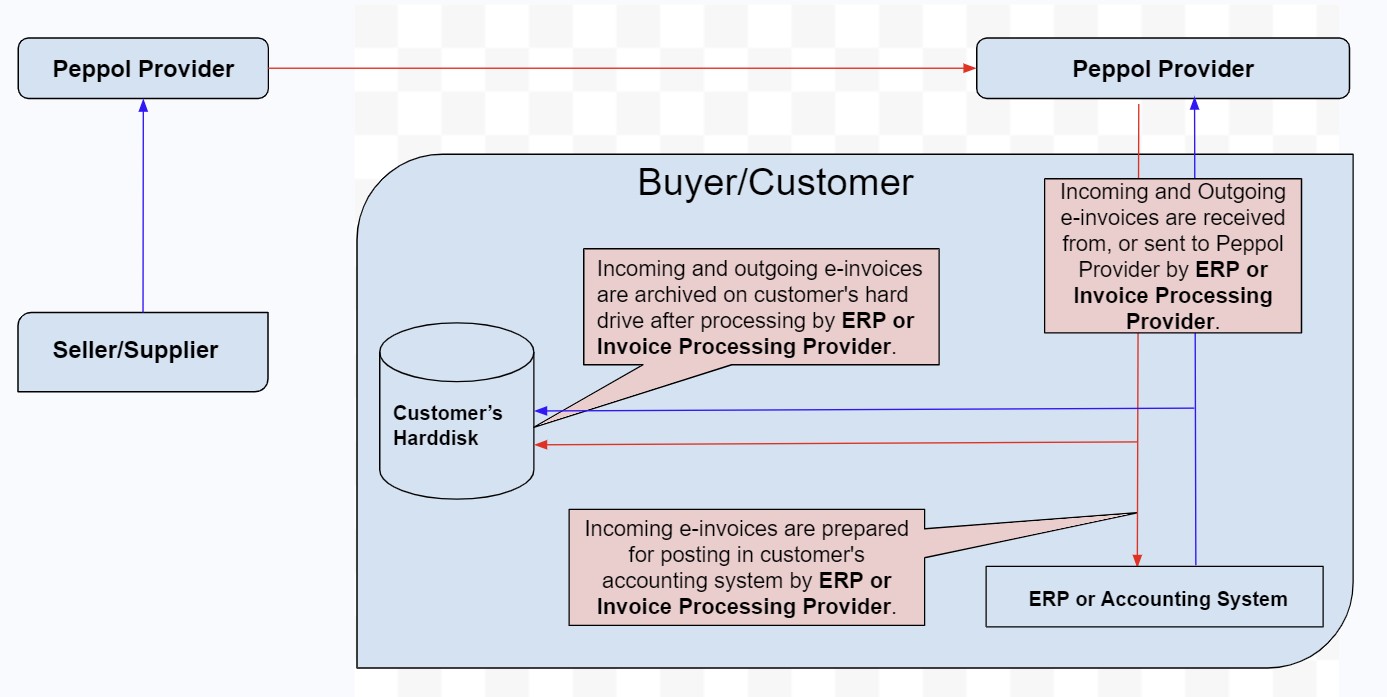
As indicated above, the new e-invoicing regulations were introduced at the initiative of government authorities, however, for the business community, these rules have proven unfeasible over the past 15 years. This is because companies are already fully occupied with existing procurement processes, which are often highly labor-intensive, as the analysis below demonstrates:
Although procurement documents are almost always exchanged digitally between supplier and customer, the lack of adequate tools frequently compels companies to print out documents such as purchase orders, bills of lading, goods receipt notes, and invoices on paper, which allows companies to collate these documents with related procurement documents in physical folders. When all required procurement documents have been received, a process taking several weeks, the company proceeds to tasks such as approving, numbering, and coding purchase invoices and invoicing sales orders.
Procurement processes as described above, can turn into massive, labor-intensive puzzles when companies handle hundreds or even thousands of active purchase and sales orders, each of which may consist of three to four separate procurement documents. Due to the heavy workload procurement entails, companies have been unable to implement the new e-Invoicing regulations over the past 15 years.
The analysis above suggests that companies would benefit from the availability of software systems that allow them to manage their procurement processes digitally. This would enable procurement documents to be linked digitally, eliminating the need to print them out on paper and then manually link them within physical files. Naturally, the relevant software systems must also provide functions to digitize and automate tasks such as the approval, numbering, and coding of purchase invoices, as well as the archiving of procurement documents.
To enable companies to comply with the new e-Invoicing regulations in the future, we have developed a Web App and this App is named:
Below, you can see the Peppol e-invoicing model upon which we based the development of our PDM App.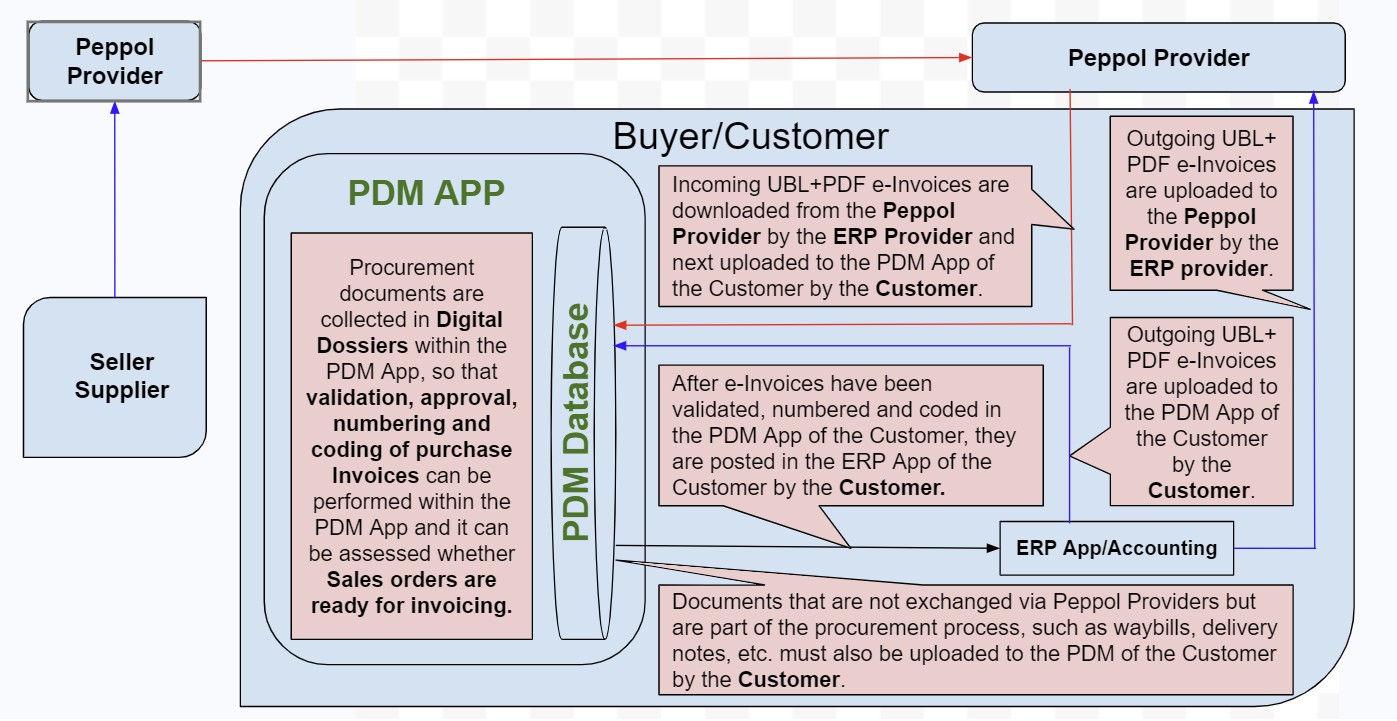
As you can see, our PDM model is derived from the four-corner model provided by government authorities, which we have supplemented with a wide range of specific procurement functions. In addition, we have added a database to our PDM model where all procurement documents are stored.
The PDM model is based on the premise that for every UBL invoice distributed, a PDF version of the same invoice is sent along with it. This approach was adopted because, while UBL invoices are suitable for tracking VAT-related financial flows between companies, they are unsuitable for the actual bookkeeping process. UBL invoices remain the legally valid invoices, of course, whereas PDF invoices serve merely a supporting role.
Documents uploaded to the PDM App are digitally grouped into shared dossiers of related documents by the PDM users, just as paper procurement documents are collected in shared paper folders.
PDM users determine the criteria used to form these dossiers themselves, however, they are frequently created based on purchase and sales orders to facilitate the validation of purchase invoices or the invoicing of sales orders.
Within the PDM App, dossiers can be located in seconds by searching by name or date. This offers a massive advantage in terms of workload compared to the old-fashioned method of manually searching for paper folders, where finding the right folder could often take several minutes.
A key principle behind the PDM design is that procurement documents no longer need to be printed on paper, resulting in the following benefits, among others:
-A significantly lower environmental impact, as paper consumption is eliminated.
-The elimination of paper and printer costs.
-Significant savings on personnel costs, as documents that do not require printing also eliminate associated tasks such as printing and filing them in binders or archives.
-Space savings, as the cabinets and rooms previously used to store and archive these documents are no longer required for that purpose.
The PDM diagram shows that All procurement documents, including those that are Not exchanged via Peppol providers but are nonetheless part of the procurement process, are stored in the PDM database. These may include bills of lading, goods receipt notes, delivery notes, and correspondence between supplier and customer, as well as photographs of documents that exist only in paper format, such documents can be digitized by taking photos and incorporated into the PDM process.
Within the PDM App, all e-Invoices (PDF, UBL, incoming and outgoing) along with their supporting documents remain easily traceable and accessible in the PDM database throughout the entire fiscal retention period of records. This contrasts with current practice, where invoices are stored in an unstructured manner on hard drives or in dusty archives, making them difficult to locate and access.
The PDM App provides an overview of Incomplete dossiers which are dossiers to which neither a purchase invoice nor a sales invoice has yet been added. This overview is used to identify Sales orders awaiting invoicing, thereby minimizing the risk of missed billing opportunities. It is also used to track purchase invoices, yet to be received.
We estimate that deploying the PDM App in organizations can reduce the number of hours spent on procurement by 40 to 50 percent.
The PDM model is based on the premise that successful digitization of the procurement process is only possible when All procurement documents and All procurement-related tasks within the process are included in the PDM App. Consequently, the PDM App supports even those functions that lie at the very periphery of procurement, such as the coding of e-Invoices.
Journal entries generated by the PDM App are digital in nature, which means they can potentially be automatically imported by ERP apps for posting to the accounting system, further enhancing the PDM App's efficiency. Naturally, this feature is only available if the ERP apps themselves support it.
The fact that PDM is a Web-based App brings additional efficiency benefits to the procurement process. Tasks such as approving purchase invoices can be performed online, eliminating bottlenecks caused by the need to wait for the relevant approvers to be physically present in the office.
External parties such as accountants and tax inspectors can also be granted access to documents in the PDM App via the internet. This further supports the original purpose of Peppol e-Invoicing, which is improving the tax authorities' enforcement of VAT legislation.
The first exercise demonstrates how the PDM App supports UBL invoices and how these invoices are displayed within the app. If you would like to try this exercise, follow these steps:
Click on "PDM App" at the top left of this page's menu, then click "Login" on the right-hand side to log in to the PDM App. You will be directed to a page displaying a list of uploaded documents. You can view any document on this list in either PDF or UBL format with the click of a button.
In the second exercise, we demonstrate how to upload UBL/PDF e-Invoice pairs to the PDM App:
To do this, click on "Upload UBL+PDF Docs." in the left-hand menu, then at the right side, click "Choose files." Select one UBL file (with an XML or JSON extension) and one file with a PDF extension, then click "Open" to upload the dossiers to the PDM App.
You will receive a notification once the dossiers have been successfully uploaded. Next, click on "Assignable Documents" in the left-hand menu; this takes you back to the page you visited earlier, but now it lists the documents you just uploaded. You can view these documents in either UBL or PDF format.
If you would like to evaluate the PDM App Exclusive and on an In-depth basis, you can request a free two-month evaluation period at the bottom of this page.
PDM is new to the e-invoicing world and can trigger a gigantic Peppol e-invoicing revolution, but certainly also an enormous environmental and sustainability revolution, so definitely a good reason to proceed with an evaluation.
We therefore urge any government body considering mandating Peppol e-Invoicing, to first examine our PDM App. By doing so, they can conclude for themselves that a mandate is unnecessary, as our PDM App provides maximum support for Peppol e-Invoicing while simultaneously driving significant efficiency gains and cost savings for businesses.
As a result, businesses will voluntarily adopt the PDM App thereby implicitly supporting Peppol e-Invoicing without the need for any compulsion.
As an English-language web application, the PDM App can be easily rolled out globally.
PDM is intuitive to use, furthermore, every page within the PDM App explains its purpose and usage, as well as how the different pages relate to one another. Should you require any further explanation, we are, of course, happy to provide it.
The free evaluation comes with no obligations, you can stop at any time and remove the documents you have entered from the PDM app. If you decide to continue using the PDM App after two months, you can simply pick up right where you left off during the evaluation period.
All you need to do now is request an Evaluation, so you can begin evaluating the PDM App in just a few days.
It was decided that PDF invoices would no longer be legally valid as of a date to be determined, but would be replaced by invoices in a structured format, such as UBL, Peppol BIS Billing 3.0, or other structured invoice formats. It was also decided that the exchange of these invoices would be mandatory via the Peppol network or other related networks.
Note: For the sake of brevity, on this website we use the terms UBL as a collective name for all structured invoice formats related to UBL, and Peppol as a collective name for all Networks related to the Peppol Network.
All e-Invoicing stakeholders from the relevant countries, such as suppliers of ERP software and e-Invoicing service providers, were requested to comply with the newly issued rules during the development of their new e-Invoicing Software and Services.
The e-Invoicing stakeholders have naturally agreed to this.
In addition to the definitions for Invoice Formats and Distribution Networks, the authorities have also issued a quadrilateral Peppol e-Invoicing scheme as a guideline for the development of new software and services, which depicts the route that e-Invoices follow during distribution via Peppol.
This scheme looks as follows:
As indicated above, the new e-invoicing regulations were introduced at the initiative of government authorities, however, for the business community, these rules have proven unfeasible over the past 15 years. This is because companies are already fully occupied with existing procurement processes, which are often highly labor-intensive, as the analysis below demonstrates:
Although procurement documents are almost always exchanged digitally between supplier and customer, the lack of adequate tools frequently compels companies to print out documents such as purchase orders, bills of lading, goods receipt notes, and invoices on paper, which allows companies to collate these documents with related procurement documents in physical folders. When all required procurement documents have been received, a process taking several weeks, the company proceeds to tasks such as approving, numbering, and coding purchase invoices and invoicing sales orders.
Procurement processes as described above, can turn into massive, labor-intensive puzzles when companies handle hundreds or even thousands of active purchase and sales orders, each of which may consist of three to four separate procurement documents. Due to the heavy workload procurement entails, companies have been unable to implement the new e-Invoicing regulations over the past 15 years.
The analysis above suggests that companies would benefit from the availability of software systems that allow them to manage their procurement processes digitally. This would enable procurement documents to be linked digitally, eliminating the need to print them out on paper and then manually link them within physical files. Naturally, the relevant software systems must also provide functions to digitize and automate tasks such as the approval, numbering, and coding of purchase invoices, as well as the archiving of procurement documents.
To enable companies to comply with the new e-Invoicing regulations in the future, we have developed a Web App and this App is named:
Procurement Document Manager, abbreviated as PDM
Below, you can see the Peppol e-invoicing model upon which we based the development of our PDM App.
Our PDM App was launched in 2026, making it not only New to the world of e-Invoicing but also Unique; indeed, no other app supports the adoption of Peppol e-Invoicing through a fully automated procurement process. The PDM App is thus the first of a new generation of apps that support Peppol e-Invoicing adoption in an Innovative and Structured way, moving away from the practice of the past 15 years, where companies attempted to manage the increased workload caused by new e-invoicing regulations by throwing manpower at the problem, often with little success.
Note: The fact that all functionalities within our PDM model are listed on the customer side of the diagram might give the impression that our PDM App is suitable only for use from a Customer role, but that is not the case.
The customer side of our PDM model represents a complete business model, incorporating not only customer functionalities but also supplier functionalities, such as sending Outgoing e-Invoices (see the blue arrows in the model). Consequently, our PDM App is fully usable by All government bodies and commercial enterprises, regardless of whether they are acting in a customer or supplier role.
The customer side of our PDM model represents a complete business model, incorporating not only customer functionalities but also supplier functionalities, such as sending Outgoing e-Invoices (see the blue arrows in the model). Consequently, our PDM App is fully usable by All government bodies and commercial enterprises, regardless of whether they are acting in a customer or supplier role.
As you can see, our PDM model is derived from the four-corner model provided by government authorities, which we have supplemented with a wide range of specific procurement functions. In addition, we have added a database to our PDM model where all procurement documents are stored.
The PDM model is based on the premise that for every UBL invoice distributed, a PDF version of the same invoice is sent along with it. This approach was adopted because, while UBL invoices are suitable for tracking VAT-related financial flows between companies, they are unsuitable for the actual bookkeeping process. UBL invoices remain the legally valid invoices, of course, whereas PDF invoices serve merely a supporting role.
Documents uploaded to the PDM App are digitally grouped into shared dossiers of related documents by the PDM users, just as paper procurement documents are collected in shared paper folders.
PDM users determine the criteria used to form these dossiers themselves, however, they are frequently created based on purchase and sales orders to facilitate the validation of purchase invoices or the invoicing of sales orders.
Within the PDM App, dossiers can be located in seconds by searching by name or date. This offers a massive advantage in terms of workload compared to the old-fashioned method of manually searching for paper folders, where finding the right folder could often take several minutes.
A key principle behind the PDM design is that procurement documents no longer need to be printed on paper, resulting in the following benefits, among others:
-A significantly lower environmental impact, as paper consumption is eliminated.
-The elimination of paper and printer costs.
-Significant savings on personnel costs, as documents that do not require printing also eliminate associated tasks such as printing and filing them in binders or archives.
-Space savings, as the cabinets and rooms previously used to store and archive these documents are no longer required for that purpose.
The PDM diagram shows that All procurement documents, including those that are Not exchanged via Peppol providers but are nonetheless part of the procurement process, are stored in the PDM database. These may include bills of lading, goods receipt notes, delivery notes, and correspondence between supplier and customer, as well as photographs of documents that exist only in paper format, such documents can be digitized by taking photos and incorporated into the PDM process.
Within the PDM App, all e-Invoices (PDF, UBL, incoming and outgoing) along with their supporting documents remain easily traceable and accessible in the PDM database throughout the entire fiscal retention period of records. This contrasts with current practice, where invoices are stored in an unstructured manner on hard drives or in dusty archives, making them difficult to locate and access.
The PDM App provides an overview of Incomplete dossiers which are dossiers to which neither a purchase invoice nor a sales invoice has yet been added. This overview is used to identify Sales orders awaiting invoicing, thereby minimizing the risk of missed billing opportunities. It is also used to track purchase invoices, yet to be received.
We estimate that deploying the PDM App in organizations can reduce the number of hours spent on procurement by 40 to 50 percent.
The PDM model is based on the premise that successful digitization of the procurement process is only possible when All procurement documents and All procurement-related tasks within the process are included in the PDM App. Consequently, the PDM App supports even those functions that lie at the very periphery of procurement, such as the coding of e-Invoices.
Journal entries generated by the PDM App are digital in nature, which means they can potentially be automatically imported by ERP apps for posting to the accounting system, further enhancing the PDM App's efficiency. Naturally, this feature is only available if the ERP apps themselves support it.
The fact that PDM is a Web-based App brings additional efficiency benefits to the procurement process. Tasks such as approving purchase invoices can be performed online, eliminating bottlenecks caused by the need to wait for the relevant approvers to be physically present in the office.
External parties such as accountants and tax inspectors can also be granted access to documents in the PDM App via the internet. This further supports the original purpose of Peppol e-Invoicing, which is improving the tax authorities' enforcement of VAT legislation.
Getting to know the PDM App
If what we have described above regarding the PDM App sounds too good to be true, we would like to dispel any doubts by giving you the opportunity to use and evaluate the PDM App Live right here on this website. To help you get started using the PDM App, we walk through two practical exercises below that you can perform within the PDM App.The first exercise demonstrates how the PDM App supports UBL invoices and how these invoices are displayed within the app. If you would like to try this exercise, follow these steps:
Click on "PDM App" at the top left of this page's menu, then click "Login" on the right-hand side to log in to the PDM App. You will be directed to a page displaying a list of uploaded documents. You can view any document on this list in either PDF or UBL format with the click of a button.
In the second exercise, we demonstrate how to upload UBL/PDF e-Invoice pairs to the PDM App:
To do this, click on "Upload UBL+PDF Docs." in the left-hand menu, then at the right side, click "Choose files." Select one UBL file (with an XML or JSON extension) and one file with a PDF extension, then click "Open" to upload the dossiers to the PDM App.
You will receive a notification once the dossiers have been successfully uploaded. Next, click on "Assignable Documents" in the left-hand menu; this takes you back to the page you visited earlier, but now it lists the documents you just uploaded. You can view these documents in either UBL or PDF format.
Please note: when evaluating the PDM App on this website, do not focus on the type or content of the documents currently present in the App. As you have likely observed, the PDM App on this site is publicly accessible, any visitor can upload any document they wish, meaning there is no logical connection between the documents present in the App.
If you would like to evaluate the PDM App Exclusive and on an In-depth basis, you can request a free two-month evaluation period at the bottom of this page.
PDM is new to the e-invoicing world and can trigger a gigantic Peppol e-invoicing revolution, but certainly also an enormous environmental and sustainability revolution, so definitely a good reason to proceed with an evaluation.
How the PDM App can accelerate the adoption of Peppol e-Invoicing
Anyone who has evaluated the PDM App on this website has found it to be a highly functional application, offering all the necessary and desired features for the smooth, fast, efficient, and cost-effective execution of procurement processes. Furthermore, the PDM App provides specific support for UBL invoices and offers easy access for tax inspectors wishing to utilize these invoices to improve their oversight of VAT compliance.We therefore urge any government body considering mandating Peppol e-Invoicing, to first examine our PDM App. By doing so, they can conclude for themselves that a mandate is unnecessary, as our PDM App provides maximum support for Peppol e-Invoicing while simultaneously driving significant efficiency gains and cost savings for businesses.
As a result, businesses will voluntarily adopt the PDM App thereby implicitly supporting Peppol e-Invoicing without the need for any compulsion.
Evaluating the PDM App
The PDM App is a web application that runs on external web servers, consequently, no PDM software needs to be installed on your systems to evaluate or use the application.As an English-language web application, the PDM App can be easily rolled out globally.
PDM is intuitive to use, furthermore, every page within the PDM App explains its purpose and usage, as well as how the different pages relate to one another. Should you require any further explanation, we are, of course, happy to provide it.
The free evaluation comes with no obligations, you can stop at any time and remove the documents you have entered from the PDM app. If you decide to continue using the PDM App after two months, you can simply pick up right where you left off during the evaluation period.
All you need to do now is request an Evaluation, so you can begin evaluating the PDM App in just a few days.